
How Renewabuild Is Transforming Modern Construction
For decades, hempcrete has been recognized as one of the world’s most promising sustainable building materials. Made from hemp hurd, lime-based binders, and water, it has introduced the construction industry to a natural, low-carbon wall system that is breathable, energy-efficient, carbon-storing, and highly comfortable for occupants.
Traditional hempcrete has played an important role in validating the performance and viability of hemp-based construction. Building on this foundation, Renewabuild’s structural hemp block system represents the next evolution—combining the environmental benefits of hempcrete with the precision manufacturing, consistency, and construction efficiency required for modern residential, commercial, and institutional projects.
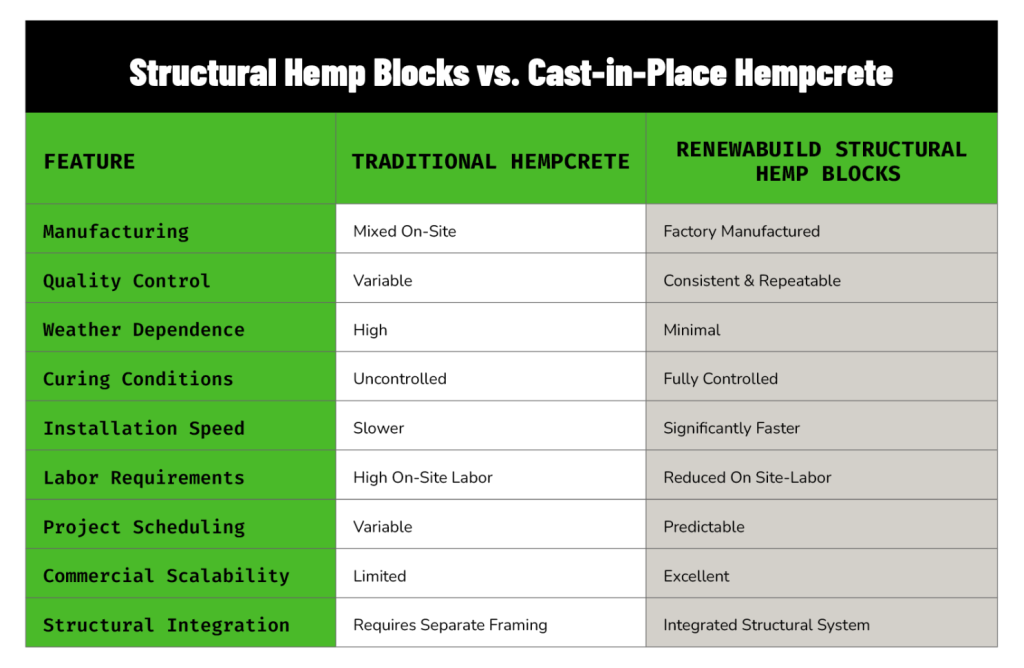
While both approaches use the same core materials and principles, they differ primarily in how they are produced, installed, and controlled during curing—not in their fundamental material science.
What is Traditional Hempcrete?
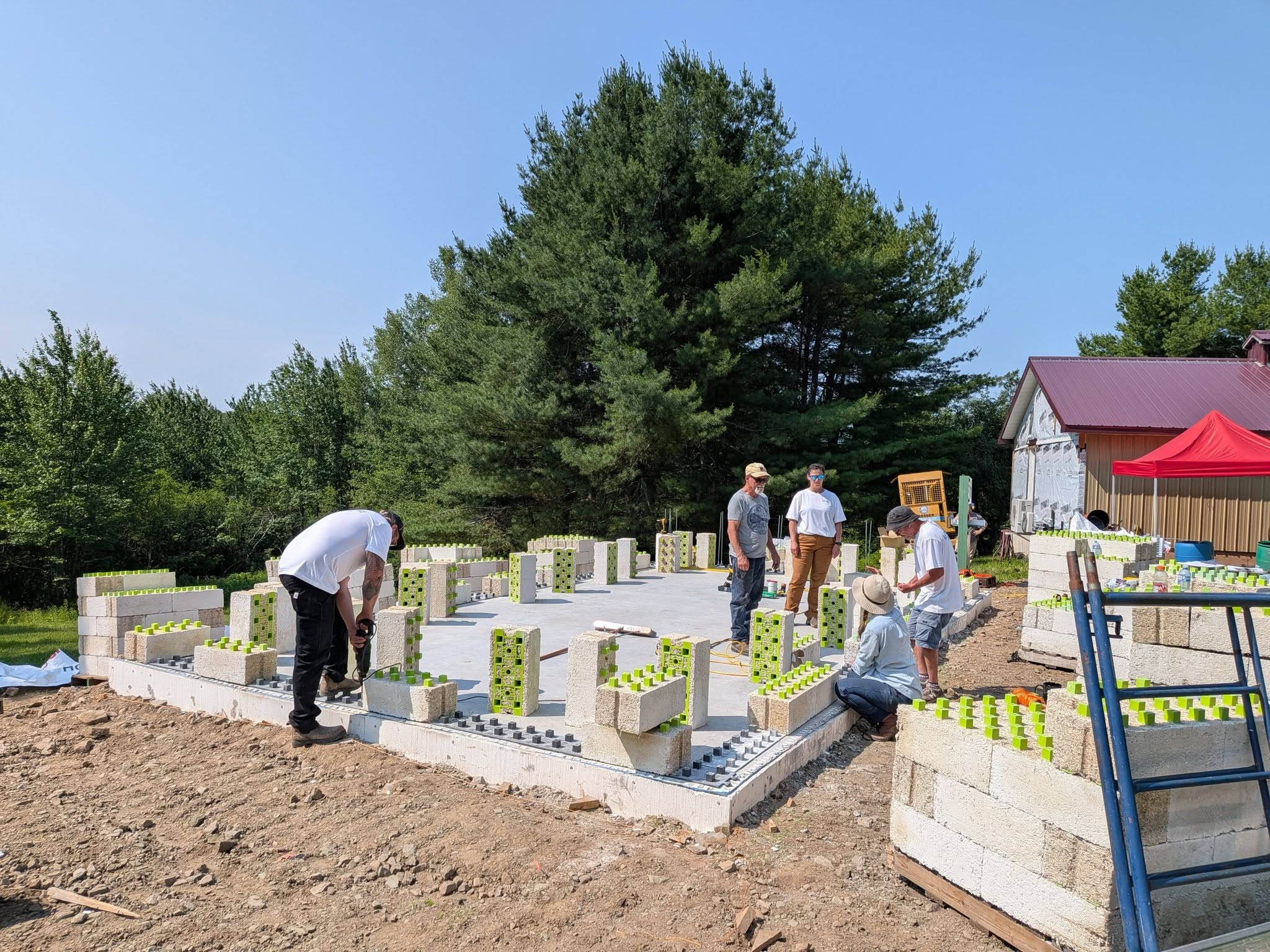
Traditional hempcrete refers to the non-structural hemp-lime material itself, made from hemp hurd, lime-based binders, and water. Because hempcrete is non-structural, it is typically installed around a separate structural frame such as wood or steel.
The most common traditional construction method is cast-in-place hempcrete, where the mixture is prepared on-site and placed into temporary wall forms surrounding the structural frame. Workers combine hemp hurd, lime, binders, and water before packing the material into wall cavities in successive lifts, where it cures in place.
Another traditional approach is the use of pressed or precast hempcrete blocks. These non-structural blocks may be produced manually and cured outdoors, or manufactured using automated equipment and controlled indoor curing rooms. Regardless of the production method, these blocks still require a separate structural system.
Traditional hempcrete systems have proven highly valuable in demonstrating the real-world performance of hemp-based construction, particularly in custom homes, renovations, and craft-driven projects.
As with many on-site construction methods, performance can be influenced by project-specific factors including:
- Installer experience and technique
- Consistency of mixing and batching
- Degree of compaction achieved in the field
- Ambient temperature and humidity during curing
- Project sequencing and site logistics
- Drying time requirements prior to finishing
These variables are well understood within the natural building sector and are typically managed through experienced crews and appropriate project planning.
Traditional hempcrete remains an important and widely respected method of hemp-based construction, particularly where on-site customization and adaptability are prioritized such as remodeling projects.
The Renewabuild Approach
At Renewabuild Great Plains, we are focused on advancing hemp-based construction into scalable, repeatable building systems suitable for broader commercial adoption and high-volume building.
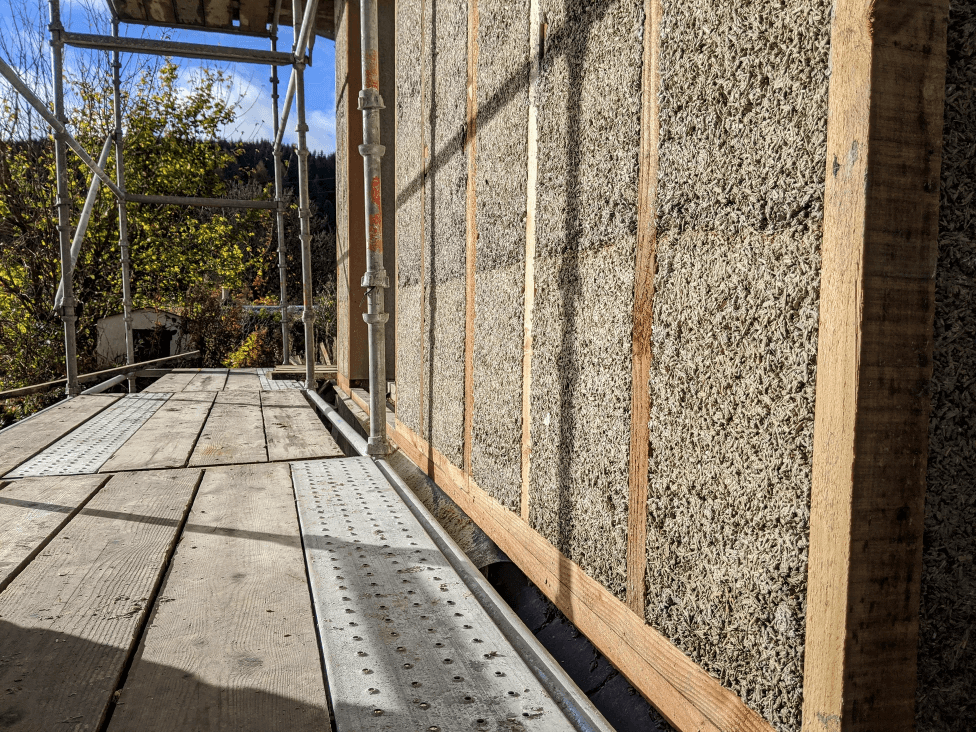
Instead of producing hempcrete on-site, Renewabuild manufactures structural hemp blocks in a controlled production environment where every stage of the process is engineered for consistency, quality, and performance.
This approach enables hemp-based construction to be applied in projects where predictability, speed, and standardized performance are critical—while maintaining the proven material science behind hempcrete.
The Renewabuild system integrates the structural component directly within the block, combining the environmental and thermal benefits of hemp-based construction with a modern, engineered building solution.
Precision Manufacturing Creates Superior Hempcrete
Renewabuild structural hemp blocks are produced using carefully controlled manufacturing processes designed to ensure uniformity across every unit.
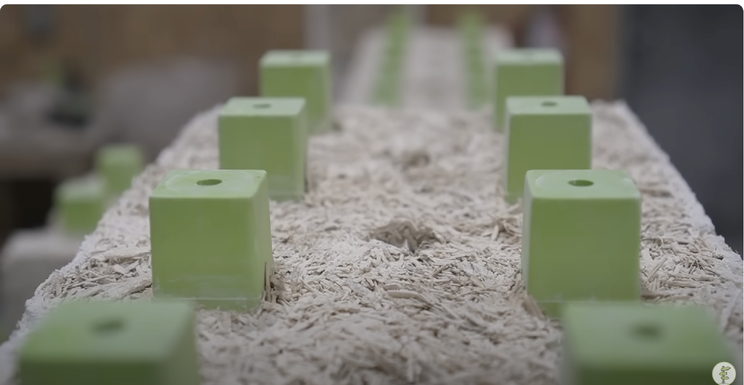
Hemp hurd, lime-based binders, and water are mixed in precise proportions and introduced in a carefully engineered sequence. The mixture is then placed into precision molds containing the structural framework.
As the molds move through the production process, controlled vibration evenly distributes the hempcrete throughout the mold while mechanical compaction applies the optimal pressure required to achieve dimensional accuracy without compromising the internal pore structure that provides hempcrete’s thermal and moisture-management benefits.
This process ensures:
- Consistent density
- Predictable structural behavior
- Accurate dimensional tolerances
- Reliable thermal performance
- Stable moisture buffering characteristics
Every block is manufactured to the same specifications, delivering repeatable quality across every project.
Controlled Curing Produces Superior Performance
A key advantage of factory-produced hemp blocks is the ability to control curing conditions.
Rather than relying on ambient site conditions, Renewabuild blocks are cured in dedicated curing chambers where temperature, humidity, and carbon dioxide levels are actively managed.
This enables the blocks to undergo hydration and carbonation under optimized conditions.
Hydration
24 to 72 hours after manufacturing
During the initial curing phase, humidity is maintained to support proper lime hydration and early structural development.
This stage is critical in establishing foundational strength. Controlled conditions help ensure uniform curing throughout the block, reducing variability between blocks.
Carbonation and Moisture Regulation
Following hydration, conditions are adjusted to reduce humidity while increasing controlled exposure to carbon dioxide.
During this stage, CO₂ reacts with the lime binder in a process known as carbonation, gradually forming calcium carbonate—a stable mineral structure that contributes to long-term strength and durability.
Successful carbonation depends on maintaining an appropriate moisture balance:
- Excess moisture can limit CO₂ penetration
- Insufficient moisture can slow carbonation reactions
By controlling both humidity and CO₂ levels, the curing process can be optimized for consistent performance and early strength development.
Final Conditioning
After controlled curing, blocks are transferred to a protected outdoor environment for an additional curing period of approximately 30 days.
This stage allows gradual moisture stabilization prior to shipment and installation, resulting in a fully conditioned building component ready for on-site assembly.
Construction Efficiency and Project Delivery
In commercial construction, schedule certainty plays a direct role in project viability.
Construction timelines influence:
- Financing costs
- Interest carry
- Labor allocation
- Equipment usage
- Project turnover timing
- Revenue generation
Traditional hempcrete construction involves multiple sequential site steps, including framing, formwork installation, material mixing, placement, curing, form removal, and drying prior to finishing work.
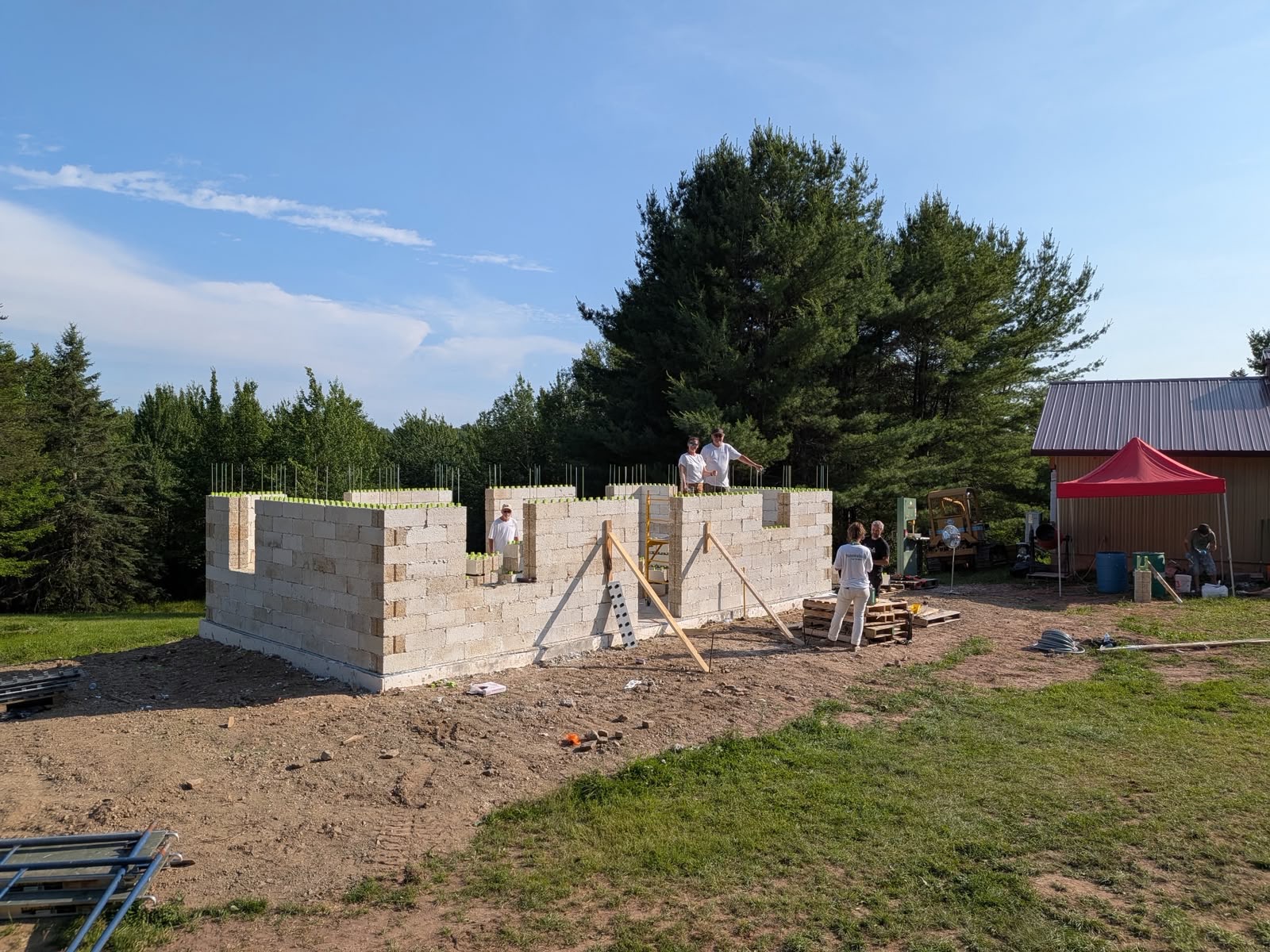
Structural hemp blocks simplify this sequence by arriving as prefabricated components ready for installation.
This enables faster wall assembly with reduced dependence on weather and site-specific curing conditions, allowing contractors to move more efficiently into subsequent phases of construction.
For developers, this improved predictability can support:
- Earlier occupancy
- Faster project turnover
- Reduced schedule risk
- Improved financial performance
Performance Beyond Sustainability
While sustainability often attracts initial interest in hempcrete, performance is what ultimately drives long-term value.
Renewabuild blocks are optimized to deliver strong hygrothermal performance.
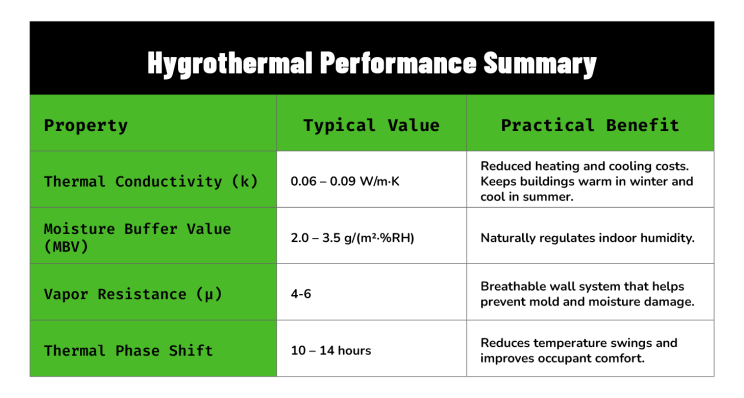
Together, these properties create buildings that are:
- More energy efficient
- More comfortable year-round
- Healthier for occupants
- Resistant to moisture-related problems
- Naturally breathable
- Carbon negative
Advancing Hemp-Based Construction
Cast-in-place hempcrete has played a foundational role in establishing the performance and credibility of hemp-based building materials.
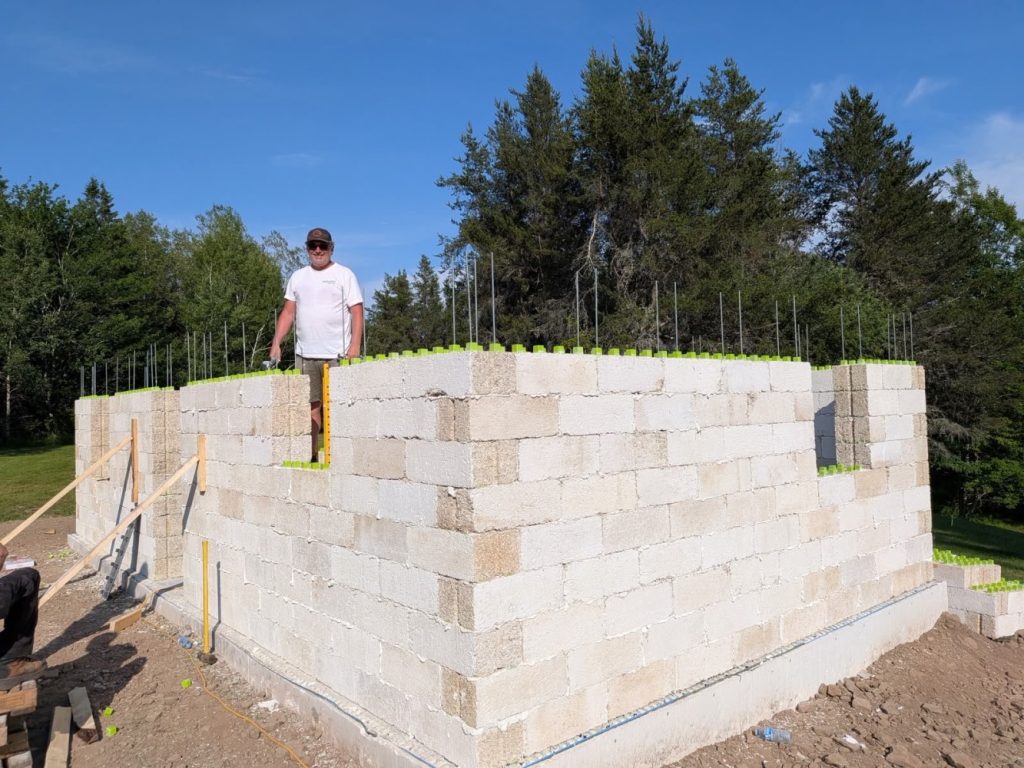
Renewabuild’s structural hemp blocks build on this foundation by introducing manufacturing precision, controlled curing, structural integration, and standardized installation processes that support broader adoption in commercial construction.
By combining material science with modern production methods, Renewabuild enables hemp-based construction to scale into projects where consistency, scheduling certainty, and repeatable performance are essential.
The future of sustainable construction is not only about reducing environmental impact.
It is about delivering materials that are reliable, scalable, predictable, and high-performing.
That is the direction Renewabuild is helping advance.
Ready to build differently?
We’re accepting project submissions. Whether you’re in early design development or ready to proceed, our technical team will review scope, system integration, and next steps.
Talk to our team